

A Vivah Muhurat is an auspicious window for the wedding ceremony, chosen from the Panchang. For most Hindu families it is the first question after the Kundli match: which dates in the year are suitable, and which of them fits the families' plans. This article summarises how 2027's marriage dates are spread across the year and explains what a Muhurat is checked for.
Marriage Muhurats in 2027, month by month
The counts below come from Astronath's Vivah Muhurat 2027 calendar, calculated for New Delhi (IST). The full list with start and end times, tithi and nakshatra for every date is on that page.
| Month | Dates | Note |
|---|---|---|
| January | 9 | From 15 January, after Kharmas ends at Makar Sankranti |
| February | 16 | The busiest month of the year |
| March | 9 | Up to mid-March, before Meen Kharmas |
| April | 9 | From 18 April, after the Sun leaves Pisces |
| May | 8 | |
| June | 0 | |
| July | 2 | 11 and 12 July |
| August–October | 0 | Chaturmas |
| November | 14 | After Dev Uthani Ekadashi |
| December | 6 | Before Kharmas |
Why some months have no dates
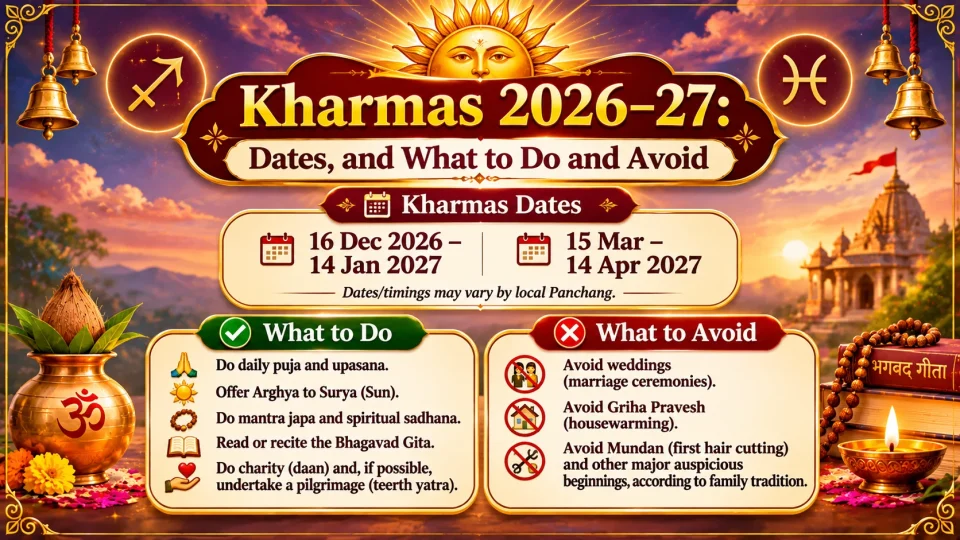
- Kharmas: while the Sun is in Sagittarius (mid-December to mid-January) and in Pisces (mid-March to mid-April), weddings are traditionally avoided.
- Chaturmas: the four months from Devshayani Ekadashi to Dev Uthani Ekadashi are a season of restraint in which marriages are not held in most North Indian traditions.
- Combust Jupiter or Venus: when Guru or Shukra, the planets of marriage, are too close to the Sun (asta), Panchangs drop wedding dates for those weeks.
- The daily factors: even in an open month, a day needs a suitable tithi, nakshatra and yoga to qualify.
What a Vivah Muhurat is checked for
- Nakshatra: classical Muhurat texts accept eleven nakshatras for marriage: Rohini, Mrigashira, Magha, Uttara Phalguni, Hasta, Swati, Anuradha, Mula, Uttarashadha, Uttara Bhadrapada and Revati.
- Tithi: Rikta tithis (Chaturthi, Navami, Chaturdashi) and Amavasya are avoided.
- Weekday and yoga: inauspicious yogas such as Vyatipata and Vaidhriti are avoided.
- Lagna: the rising sign at the time of the pheras should be strong, with no malefic in the seventh house.
- The couple's charts: the Moon's transit relative to the bride's and groom's Moon signs (Chandra bala) and Jupiter's position (Guru bala) for the bride are commonly checked.
- Bhadra and Rahu Kaal are avoided for the main ritual.
Practical tips for choosing a date
- Start with the Kundli matching of the couple.
- Shortlist dates from the 2027 list that work for the families and the venue.
- Ask an astrologer to check those dates against both charts and to fix the exact Lagna time for your city.
- Book early for February and November: they have the most dates and venues fill quickly.
Conclusion
2027 has 73 marriage Muhurats for New Delhi in Astronath's calculation, most of them in February and November, and none in June or from August to October. Use the month-wise list to plan, and confirm the final date and Lagna time for your city and your charts.
Frequently asked questions
Which month of 2027 has the most marriage Muhurats?
February, with 16 dates in Astronath's New Delhi calculation, followed by November with 14.
Are there wedding dates in June 2027?
Astronath's 2027 calculation for New Delhi found none in June, and only two in July (11 and 12 July). There are none from August to October.
Is a Muhurat the same for every city?
No. The tithi and nakshatra are the same across India on most days, but sunrise and the Lagna times differ by place, so the exact window must be calculated for the wedding city.
Can we marry during Kharmas if no other date works?
Tradition advises against it, and most families wait. If circumstances make it unavoidable, discuss it with your family priest or astrologer.
Sources and references
- Astronath: Vivah Muhurat 2027 (New Delhi, IST) — Full list with times, tithi and nakshatra; calculated, not yet reviewed by an astrologer
Dates and timings were checked against these references on the date shown above. Timings depend on your city: confirm them in a Panchang for your location.
Astrology is a traditional system of interpretation, not a science. Articles are for reflection and guidance, are not guaranteed, and are not a substitute for medical, legal, financial or psychological advice. Read our astrology disclaimer.