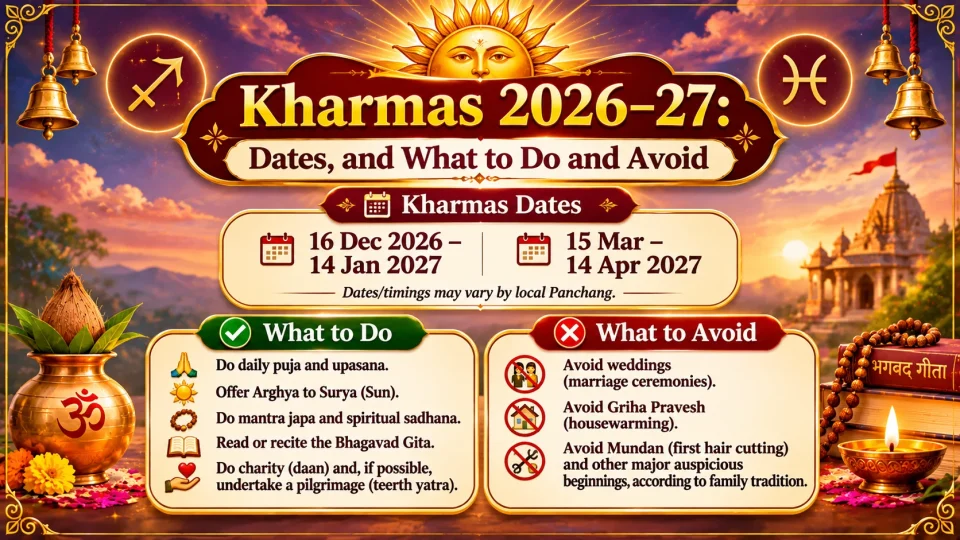


Makar Sankranti marks the Sun's entry (sankranti) into Makara, the sidereal sign of Capricorn. Unlike most Hindu festivals it follows the solar calendar, which is why it usually stays around 14 or 15 January. It also ends Kharmas, the month in which weddings and other auspicious ceremonies are traditionally avoided, and begins the Sun's 'northward' half of the year in the traditional reckoning.
Makar Sankranti 2027 date: 14 or 15 January?
Drik Panchang gives the Sun's entry into Capricorn at about 9:14 PM IST on Thursday, 14 January 2027. The Sankranti itself happens at that moment, but the bathing, charity and puja are done in the Punya Kaal, a window of daylight linked to the Sankranti. When the Sun changes sign after sunset, the Punya Kaal moves to the next morning.
| Event | When |
|---|---|
| Sun enters Capricorn (Makar Sankranti moment) | About 9:14 PM, Thursday 14 January 2027 |
| Punya Kaal and festival day in many Panchangs | Friday, 15 January 2027 (from sunrise) |
| Shown on some calendars and holiday lists | Thursday, 14 January 2027 |
Significance
- End of Kharmas: the Sun leaves Sagittarius (Dhanu), whose month is avoided for weddings and Griha Pravesh, so auspicious ceremonies resume.
- Uttarayan: the festival is traditionally treated as the start of the Sun's northward course and an auspicious half of the year. (Astronomically the winter solstice is around 21 December; the date drift is due to the sidereal zodiac used in Vedic astrology.)
- Harvest festival: across India it celebrates the winter harvest and longer days.
- Surya and Shani: Capricorn is ruled by Saturn, and the story of the Sun visiting his son Shani's house is told to explain the day's emphasis on reconciliation and charity.
Rituals
- Take a holy bath (Ganga snan where possible; Prayagraj's Magh Mela begins around this time).
- Offer arghya to the Sun with water, red flowers and a few grains of rice or sesame.
- Give daan, especially til (sesame), jaggery, khichdi, blankets and warm clothes.
- Eat and share til-gud sweets and khichdi, the foods traditionally linked to the day.
One festival, many names
| Region | Name and custom |
|---|---|
| Gujarat, Rajasthan | Uttarayan: kite flying |
| Punjab, Haryana | Lohri on the eve; Maghi on the day |
| Tamil Nadu | Thai Pongal: the four-day harvest festival with Pongal cooked in new pots |
| Assam | Magh Bihu (Bhogali Bihu): feasting and community bonfires |
| Bihar, Uttar Pradesh | Khichdi Parv: dahi-chura, til and khichdi |
| Maharashtra | Til-gul exchange: 'tilgul ghya, god god bola' |
| Karnataka, Andhra Pradesh, Telangana | Sankranti / Pedda Panduga: ellu-bella, rangoli and cattle worship |
Conclusion
In 2027 the Sun enters Capricorn late on 14 January, so many Panchangs observe Makar Sankranti and its Punya Kaal on Friday 15 January, while some calendars list the 14th. Whichever date your tradition follows, the day brings Kharmas to an end and is celebrated with a holy bath, sesame and jaggery, and charity.
Frequently asked questions
Is Makar Sankranti 2027 on 14 or 15 January?
The Sun enters Capricorn at about 9:14 PM IST on 14 January 2027. Because that is after sunset, Panchangs that follow the Punya Kaal rule observe the festival on 15 January 2027; some calendars still show 14 January.
Why does Makar Sankranti sometimes fall on 15 January?
The Sun's entry into sidereal Capricorn happens a little later each year, and when it falls after sunset the Punya Kaal moves to the next day. Over the centuries the date has slowly drifted later.
Does Kharmas end on Makar Sankranti?
Yes. Kharmas is the period while the Sun is in Sagittarius (Dhanu); it ends when the Sun enters Capricorn. Read more in our article on Kharmas 2026–27.
Sources and references
- Drik Panchang: Sankranti dates 2027 — Makar Sankranti moment, 14 January 2027
- Drik Panchang: Makar Sankranti — Punya Kaal and observance day
Dates and timings were checked against these references on the date shown above. Timings depend on your city: confirm them in a Panchang for your location.
Astrology is a traditional system of interpretation, not a science. Articles are for reflection and guidance, are not guaranteed, and are not a substitute for medical, legal, financial or psychological advice. Read our astrology disclaimer.