

Choghadiya is a quick way to pick a good time of day. It is widely used in Gujarat, Rajasthan and Maharashtra, and across India for travel, business deals and small auspicious beginnings, when there is no time to fix a full muhurat. The word comes from chau (four) and ghadi: each Choghadiya is about four ghatis, roughly 90 minutes. For the wider idea of auspicious timing, see What is Muhurat?
How Choghadiya is calculated
- The time from sunrise to sunset is divided into eight equal parts: these are the day Choghadiyas.
- The time from sunset to the next sunrise is divided into eight more: these are the night Choghadiyas.
- Each part is about 90 minutes only near the equinoxes. In winter, day Choghadiyas are shorter and night ones longer, and the reverse in summer.
- Because sunrise and sunset differ by city, Choghadiya timings are local. Use a calendar set to your own city.
The seven types of Choghadiya
| Choghadiya | Ruling planet | Nature | Traditionally good for |
|---|---|---|---|
| Amrit | Moon | Best | Almost any auspicious work |
| Shubh | Jupiter | Good | Marriage, puja, religious and family ceremonies |
| Labh | Mercury | Good | Business, trade, study and starting new learning |
| Char | Venus | Good (neutral) | Travel and work that involves movement |
| Udveg | Sun | Inauspicious | Avoided for new beginnings; some use it for government-related work |
| Kaal | Saturn | Inauspicious | Avoided for auspicious work |
| Rog | Mars | Inauspicious | Avoided for auspicious work and travel |
Day Choghadiya table for each weekday
The first day Choghadiya is the one ruled by the weekday's lord, and the rest follow a fixed order. The eighth period repeats the first.
| Day | 1 | 2 | 3 | 4 | 5 | 6 | 7 | 8 |
|---|---|---|---|---|---|---|---|---|
| Sunday | Udveg | Char | Labh | Amrit | Kaal | Shubh | Rog | Udveg |
| Monday | Amrit | Kaal | Shubh | Rog | Udveg | Char | Labh | Amrit |
| Tuesday | Rog | Udveg | Char | Labh | Amrit | Kaal | Shubh | Rog |
| Wednesday | Labh | Amrit | Kaal | Shubh | Rog | Udveg | Char | Labh |
| Thursday | Shubh | Rog | Udveg | Char | Labh | Amrit | Kaal | Shubh |
| Friday | Char | Labh | Amrit | Kaal | Shubh | Rog | Udveg | Char |
| Saturday | Kaal | Shubh | Rog | Udveg | Char | Labh | Amrit | Kaal |
How to use Choghadiya well
- Choose Amrit, Shubh or Labh for important beginnings, and Char for starting a journey.
- Avoid Rahu Kaal even if it overlaps a good Choghadiya; see What is Rahu Kaal?
- Use Choghadiya for everyday decisions. For marriage, griha pravesh or a vehicle purchase, a full muhurat with tithi, nakshatra and lagna is preferred; see Vehicle purchase muhurat.
- Check that the tithi is not a Rikta tithi and that Bhadra is not running for major work.
Choghadiya vs Hora
Hora divides the day into 24 planetary hours, each ruled by a planet in turn. Choghadiya uses eight longer periods. Many people check the Choghadiya first and then the Hora of the planet linked with their work, such as the Mercury Hora for business.
Conclusion
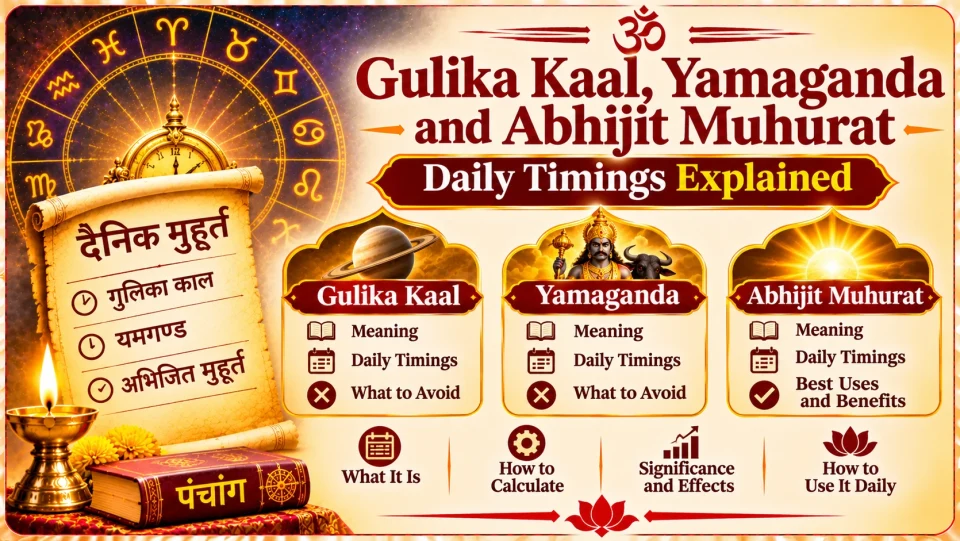
Choghadiya is a practical daily timing tool: three good periods (Amrit, Shubh, Labh), one neutral (Char) and three to avoid (Udveg, Kaal, Rog). Check today's timings for your city in the Panchang calendar, and learn the other daily periods in Gulika Kaal, Yamaganda and Abhijit Muhurat.
Frequently asked questions
What is Choghadiya?
A Vedic timing system that divides the day and the night into eight periods each, roughly 90 minutes long, and labels each one as good or bad for beginning work.
Which Choghadiya is best?
Amrit is considered the best. Shubh and Labh are also good, and Char is good for travel. Udveg, Kaal and Rog are avoided for auspicious work.
Is Choghadiya the same everywhere?
No. It is counted from local sunrise and sunset, so the timings change with your city and the season.
Can I use Choghadiya for marriage?
Choghadiya can support the choice of time, but marriage needs a full muhurat that also checks tithi, nakshatra, lagna and the couple's charts.
Sources and references
Dates and timings were checked against these references on the date shown above. Timings depend on your city: confirm them in a Panchang for your location.
Astrology is a traditional system of interpretation, not a science. Articles are for reflection and guidance, are not guaranteed, and are not a substitute for medical, legal, financial or psychological advice. Read our astrology disclaimer.